
The quiet power of guar, and why it matters for beauty
A humble Indian crop is quietly reshaping how we think about conditioning, texturising and sustainability in formulation — and Syensqo has been at the heart of it for a decade.

You probably haven't thought much about guar beans. They're a legume crop, grown in the arid, sun-baked fields of Rajasthan, India, and for most of their history, they've been better known as cattle feed and a food industry thickener than as a beauty ingredient. But that's quietly changing. Over the past decade, guar derivatives have been gaining ground in cosmetic formulation as a credible, natural alternative to some of the industry's most widely used and increasingly scrutinised synthetic ingredients.
This isn't just an ingredient story. It's a supply chain story, a consumer behaviour story, and increasingly a regulatory story. Let's unpack it.
What is guar, and what does it do in a formula?
Guar is processed into a range of derivatives, most commonly guar hydroxypropyltrimonium chloride, a cationic polymer that conditions, smooths, and helps active ingredients deposit onto hair and skin. In simpler terms: it does a lot of what silicones and synthetic conditioning polymers do, but from a natural, biodegradable source.
For formulators, this matters for several reasons. Silicones have long been the workhorses of haircare and skincare. They deliver that instantly recognisable smooth, slippery, glossy finish. But they are also persistent in the environment, difficult to biodegrade, and increasingly on the radar of both regulators and consumers pushing for cleaner formulas. Synthetic polymers like polyquaterniums are similarly effective and low-cost, but they carry the same environmental question marks.
Guar derivatives offer a route out of that trade-off. Depending on the derivative used, they can condition, thicken, texturise, and emulsify, while ticking the boxes that clean beauty and sustainability-conscious formulators are now expected to tick.
A market example: the Sustainable Guar Initiative
One of the more developed examples of how guar is being brought to market sustainably is the Sustainable Guar Initiative (SGI), founded in 2015 by Syensqo (as Solvay). Its is a ground-level programme to build a traceable, ethical, and self-reliant guar supply chain in Rajasthan's Bikaner region. Syensqo is working in partnership with NGO TechnoServe and local processor Hindustan Gum & Chemicals. Brand partners, including L'Oréal, Henkel and Procter & Gamble, later joined the initiative.
Ten years in, the SGI spans 62 villages and has engaged over 12,300 farmers, with a deliberate focus on empowering women farmers in the region.
Beyond scale and structure, the SGI initiative is built around four interconnected pillars:
- agronomic improvement (better farming practices, higher yields),
- market access (connecting farmers to stable buyers),
- environmental practices (reducing water use, improving soil health),
- social equity (training, fair income, women's economic participation).
The goal is for farming communities to become genuinely self-reliant, which is a more meaningful model of ethical sourcing than a standard certification label alone.
It is part of the definition of sustainable beauty, where we generate prosperity for the people we work with by giving them skills and allowing them to improve their quality of life. It's not just about making profits but about generating a more prosperous life through knowledge throughout the life cycle.
For beauty brands increasingly scrutinised on the depth of their sustainability commitments, this SGI offers a supply chain story with in-depth information. It also involves the Community which is harder to replicate and harder to greenwash than a simple organic certification.
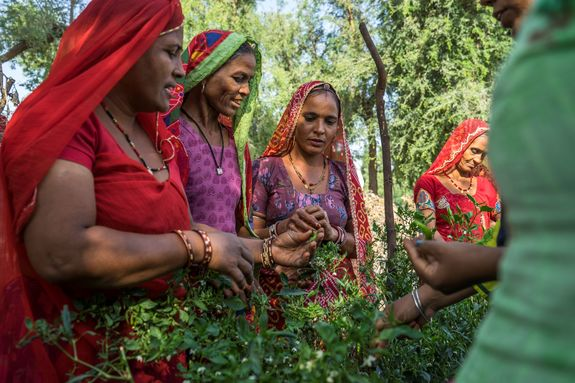
One nuance worth noting: there is currently no global certification system for guar (unlike for cocoa or coffee), and the SGI has essentially laid the foundation for what sustainable guar standards could look like.
What guar can replace, and across which categories
The guar formulation portfolio available on the market is broader than most people outside the formulation world realise. Across the available derivatives, several distinct formulation challenges can be addressed.
Silicones. Certain guar derivatives are now positioned as silicone alternatives for both haircare and skincare formulations, delivering comparable sensory benefits: smooth feel, easy combing, a natural finish, without the biodegradability concerns. Syensqo's Dermalcare® LIA MB is one example currently on the market, described as a universal silicone alternative for both categories. This is potentially a significant application, given the scale of silicone use in beauty and the growing consumer demand for natural alternatives.
Polyquaterniums. Cationic guar derivatives have been developed as direct replacements for Polyquaternium-10 (PQ-10), one of the most common conditioning polymers in shampoos and rinse-off treatments, working particularly well in sulfate-free and silicone-free formulations. Syensqo's Jaguar® Optima offers a derivative. For body cleansing and liquid soap formats, including mild and baby products, Naternal™ SOFT addresses the replacement of polyquaternium-7. The newer Naternal™ Care XTRA, derived from fenugreek, extends this further into conditioning and repair haircare.

Synthetic thickeners and rheology modifiers. COSMOS-approved guar thickeners provide 100% natural, biodegradable alternatives to conventional synthetic rheology modifiers in skincare. The Jaguar® range from Syensqo includes COSMOS-approved options in this space. This is an often-overlooked application, given how central thickening agents are to the texture and sensory experience of skincare formulas.
Oil structurants for colour cosmetics. Natural oil rheology modifiers derived from guar are finding application in skincare, scalp care, and colour cosmetics, a category where natural alternatives have historically been limited and performance trade-offs more acute. Syensqo's OLEOGY™ range is one example of this newer application territory.
In terms of beauty categories, the reach spans virtually the full spectrum: shampoos, conditioners, masks, leave-in treatments, serums, and baby haircare; texturisers, emulsifiers, and emollients in skincare; body cleansers and liquid soaps in bodycare; and oil-based formulations in colour cosmetics and scalp care. COSMOS-approved options are available, enabling cleaner INCI lists with multifunctional ingredients, which is a meaningful formulation benefit as labels come under increasing consumer scrutiny.
The price question, and why the answer is more interesting than you'd expect
The instinct is to assume that natural, certified, ethically sourced ingredients carry a significant price premium and therefore belong primarily in luxury or premium formulations. The reality is more interesting.
At bulk, cosmetic-grade market rates, guar derivatives are roughly in the $7 to $15 per kilogram range. Standard silicone fluids range from around $3 to $15 per kilogram at commodity grades, but specialist hydrophilic cosmetic silicones can reach $15 to $40 per kilogram. Polyquaternium-10, produced at a massive global scale, comes in around $3 to $8 per kilogram.
The honest comparison: guar derivatives carry a premium of roughly 1.5 to 2 times the cost of standard synthetic conditioning polymers, not the three or four times that the "natural luxury" framing might suggest. At performance-equivalent speciality silicone grades, the gap narrows further, and in some cases, inverts.
The real cost premium in choosing certified guar isn't the raw ingredient price. It's the certification, traceability infrastructure, and COSMOS compliance. That distinction matters because those costs aren't just overhead. They're what make a sustainability claim defensible and, increasingly, legally valid.
re-sources perspective
Sustainable guar offers a natural alternative that is more expensive than silicones or polymers, but at a modest 1.5 to 2x premium, it becomes commercially accessible well beyond the luxury tier. This opens the door to salon haircare, mid-market skincare, and mass-premium bodycare, categories where sustainability credentials are becoming a genuine competitive differentiator rather than a nice-to-have.
Brands choosing guar-based ingredients aren't paying a luxury tax. They're making an active, values-led decision at a commercially viable cost. And that distinction matters enormously as we consider who the consumer will be in 2026.
Consumers are increasingly seeking products that are better for their health and the planet, but they're also looking for value. These two demands are no longer mutually exclusive, and the brands that understand this are positioning themselves for the next decade rather than the last. Kantar's research on "eco-actives" suggests these shoppers will go far beyond label reading to interrogate supply chains and certifications. But mainstream consumers are catching up, too. They're learning to read ingredient lists. They're becoming aware of the cumulative impact of their purchasing choices. And they're getting better at spotting the gap between a brand that talks about sustainability and one that has actually built it into its supply chain.
Choosing certified or SGI-sourced ingredients does cost more. But it also provides something that will become increasingly critical in the European Union and other markets: a defensible, verified claim. Under the EU Green Claims Directive, vague environmental claims without substantiation will be subject to legal challenge. Certified, traceable ingredients with documented ethical supply chains aren't just a marketing asset. They're a compliance one.
Programmes like the Sustainable Guar Initiative offer something that most greenwashing cannot: specificity. 62 villages. 12,300 farmers. Four documented pillars. A ten-year track record. That level of detail is what gives a claim its credibility and its staying power.
Where does Guar go from here?
The guar story is, in many ways, still in its early chapters. The case has been made for early adopters and innovation-led brands. The next phase will be written by mid-market and retail-led brands, and by the regulatory environment that increasingly pushes all players to substantiate their claims.
There is also a broader horizon worth watching. The future of sustainable formulation ingredients is unlikely to be a single category. It will be a price ladder: naturally sourced ingredients like guar at one level, biofermentation-derived alternatives at another, and emerging biotech-derived actives at the premium end. Different price points, different performance profiles, different claim frameworks. The opportunity for brands will be to find the right ingredient for their positioning, their consumer, and their regulatory context, rather than defaulting to synthetic because it's cheaper or to natural because it's marketable.
Guar is a compelling example of what that looks like when it's done with full-cycle impact: a natural origin, a traceable supply chain, a farmer-impact story, accessible COSMOS credentials, and a price point that makes it viable for more than just a niche luxury market.
The question now isn't whether the beauty industry will move in this direction. The direction is already set. The question is how quickly the mainstream catches up, and which brands will lead the way.
Sources
Sustainable Guar Initiative programme documentation (Syensqo)
- Sustainable Guar Initiative (SGI): https://www.syensqo.com/en/solutions-market/consumer-goods/personal-care/sustainable-guar-initiative
- 10th anniversary press release: https://www.syensqo.com/en/press-release/syensqo-celebrates-10-years-sustainable-guar-initiative
- Syensqo Fund SGI page: https://fund.syensqo.com/protecting-planet/sustainable-guar-initiative
- Feature article (2023): https://www.syensqo.com/en/article/new-standard-sustainble-farming
TechnoServe partnership reporting
- 10-year impact report: https://www.technoserve.org/blog/sustainable-agriculture-guar-initiative-india/
- SGI project page: https://www.technoserve.org/fight-poverty/projects/demonstration-and-development-of-improved-practices-in-the-guar-market-syst/
- Farmer story feature: https://www.technoserve.org/blog/guar-gum-initiative/
Kantar eco-actives / sustainability research
- Who Cares? Who Does? main study page: https://www.kantar.com/campaigns/who-cares-who-does-in-the-fmcg-industry
- Eco-actives rise and fall: https://www.kantar.com/inspiration/the-rise-fall-and-rise-again-of-ecoactive-consumers
Winning with sustainability (UK): https://www.kantar.com/uki/inspiration/sustainability/2021-wp-winning-with-sustainability

