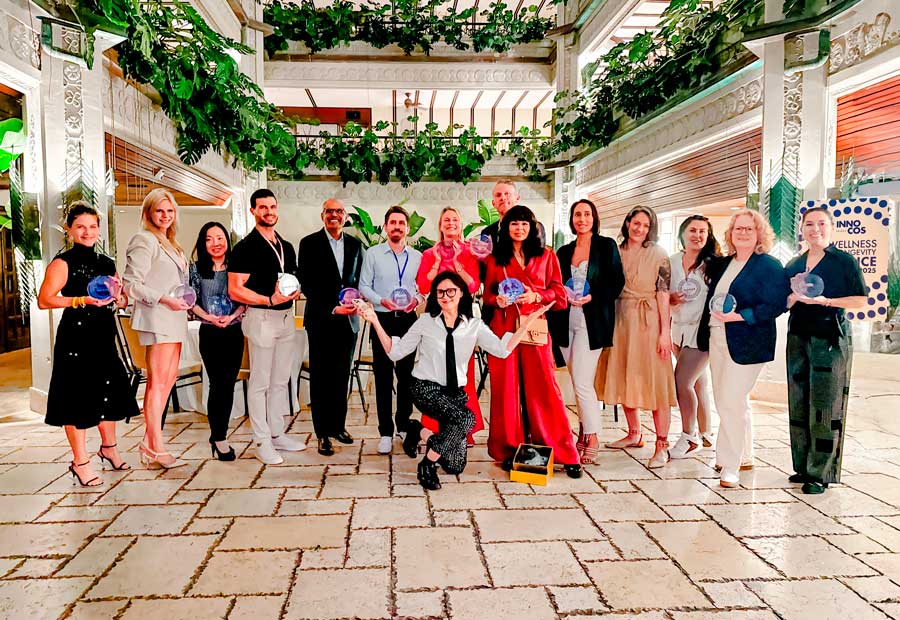
The Proof is in the Science: 3 Trends Reshaping Longevity in Beauty from INNOCOS Paris 2026
The INNOCOS Paris 2026 Luxury, Beauty & Longevity Summit concluded that luxury is shifting from being asserted through heritage and packaging to being earned through proof.

For brand founders focused on growth and scaling, this change signals the single most important commercial shift of the year. Here are three essential takeaways from Innocos Paris defining the future premium beauty landscape.
Longevity is the New Luxury Currency
Longevity has replaced "anti-ageing" not just in vocabulary but in the proof point. Skin is now understood as a biomarker, meaning a readable surface that reflects systemic health, cellular ageing, inflammation and microbiome balance. Measurement allows for adjustments wherever needed that will improve well ageing, in other words, longevity. Think biohacking. Think Vitamins. Think overall health. The boundaries between health and beauty are merging.
We are now looking for biological signals: visible energy, posture, clarity, and a biological age lower than chronological age.
- Proof is the Positioning: Traditional perception trials ("92% of women agreed") are no longer sufficient to justify premium price points. Credibility now requires biomarker-based, instrument-measured, and AI-scored efficacy studies as the baseline. The summit highlighted that brands and founders navigating the longevity sphere should reallocate budget from brand-level advertising to clinical trials, treating this expenditure as a marketing line rather than an R&D line.
- The Systems View: The product design brief has moved from treating a symptom to measuring a biomarker. Skin is now understood as a readable surface that reflects systemic health, inflammation, and cellular ageing. The strongest brands are positioning their pricing against what customers spend annually on their entire longevity stack (e.g., sleep trackers, peptide protocols), not just against competitor skincare SKUs.
Science and luxury are no longer in tension. They are merging. Houses like Dior and Coty are investing as heavily in formulation science as in creative direction, while L'Oréal BOLD signalled that the corporate venture lens is now explicitly looking for brands that combine clinical evidence with luxury design.
Big brands are now organised for science-luxury integration. Small brands must choose their two axes and go deep.

Distribution is Now Four Channels, Not One
The distribution landscape has split into four distinct channels: beauty retail, clinical/medical, wellness/hospitality, and digital commerce. While all channels are meaningful, premium brands are increasingly winning in the middle two.
- The New Exclusivity: Pursuing broad, mass-retail distribution is rarely the highest-value path for a premium brand. Exclusivity has evolved from limited shelf placement to being curated into an experience that the transaction alone cannot replicate.
- High-Value Triple-Play: A combination of curated boutique distribution, clinical partnerships, and a hospitality- or wellness-adjacent channel often delivers higher margins, a stronger brand story, and better data. Brands and Founders are encouraged to pilot a boutique + clinic + hospitality triple-play in one market to compare its twelve-month customer lifetime value (LTV) against mass-retail doors.
The narrative of luxury and longevity is not monolithic: France reads it as elegance and mastery; the United States as biohacking and performance; China as vitality and harmony; the Middle East as heritage combined with science; Japan as ritual and subtlety.
Going "global from day one" almost always dilutes the proposition. The strategic move is to pick a geography of authority, the market that most naturally validates the brand's story, and lead the narrative, and expand from there. And the brand will become an icon worth chasing.
It reminds me of an analogy: after the time of the empires (Roman, British), we had the time of the countries (America, Russia), and now it is about the cities (London, NY, Paris). Is it time for the ONE location? Just a coffee that pops out and becomes a cultural icon. Have you seen the queues in the streets for a beauty pop-up or the new bakery owned by a young entrepreneur swapping a career in advertising for a baking oven?

Hero Ritual Beats Broad Portfolio
For the scale most founders aspire to, one defensible ritual with a measurable outcome outsells ten me-too SKUs. The modern luxury customer buys into protocols and rituals, not stand-alone products.
- Retention Driver: Product is an entry point into a ritual, and the ritual itself is the primary retention driver. Brands that intentionally design a ritual (the morning protocol, the evening stack) outperform those selling isolated products.
- Ecosystem Design: Founders who design a "ritual ecosystem" around their hero SKU, for instance, by pairing a hero topical with an ingestible companion, outperform those who sell products in isolation. The strategic implication is to audit SKUs for one hero ritual and ruthlessly deprioritise launches that do not reinforce it.
Exclusivity still matters, but the meaning has evolved. "Exclusive" no longer means only "sold in one store"; it increasingly means "curated into an experience the transaction alone cannot replicate." For a founder, the practical lesson is that pursuing broad Sephora or Douglas distribution is rarely the highest-value path for a premium brand.
A combination of curated boutique distribution, clinical partnerships, and a hospitality or wellness-adjacent channel often delivers higher margins, a stronger story, and better data, at the cost of slower top-line growth.
The new exclusivity is about curated experiences that shelf placement cannot reproduce.

Look at the trend in Sephora US. A few brands have closed down recently, after even securing the holy grail, "a presence at Sephora". And yet they went bankrupt. Consumers are looking for custom insights, priority and special access, not just mass. And the longevity and luxury treatments are not just for the luxury customer. In the current economic environment, people would rather save on several expenses (restaurant, clothing, etc) to treat themselves with a wellness session.


