Natura aims to be fully regenerative by 2050
Beyond sustainability, the leading Beauty and Personal Care brand in Latin America is targeting social impact for a more holistic approach to green commitments, measured through an iP&L (integrated Profit & Loss)

The 2050 statement is not new, but with a recent interview with Diego Costa, Senior Marketing Director, and Angela Pinhati, Chief Sustainability Officer, we took stock of Natura's progress on its sustainability journey.
Natura aims to make the company fully regenerative by 2050, meaning that “regeneration goes beyond simply offsetting or mitigating negative impacts. For Natura, its business will be considered regenerative when it creates a positive impact across each of the four distinct capitals: financial, human, social, and natural.”
"Committed to generating value for its entire chain, the Natura brand is taking an innovative step in measuring the impacts generated by its business in the social, environmental and human spheres, by launching its integrated P&L, called iP&L. It is an integrated management tool that allows Natura to account, in addition to financial results, for the impact of corporate performance on the environmental, social, and human dimensions. The study’s results consider several other fronts of the company’s performance, such as carbon emission and offsetting, circularity, regeneration and conservation of biomes, and income generation for the network (and its impacts on health and welfare). According to the model’s application, based on 2024 results, for every R$ in sales at Natura, 1.5 R$ in societal value is generated."
Natura's results
Natura reports an overall revenue of R$ 22.2 billion in 2025, and completed the sales of Avon International and Avon Russia, marking the final milestone in Natura’s corporate streamlining and capital structure reorganisation. Natura has over 3.2 million consultants - the historic selling platform for Beauty in Brazil - and approximately 14,000 employees across Latin America.
In line with its climate transition plan, Natura reduced absolute carbon emissions by 10.2% in 2025. This was driven by initiatives such as the adoption of biomethane at their Cajamar facility, which generated productivity gains of over 400% in the refuelling cycle and is expected to prevent approximately 1,300 tons of carbon emissions. On circularity, Natura achieved 29% post-consumer recycled content in packaging, exceeding its 25% target a year ahead of schedule.
In terms of sustainability, Natura is recognised as the World’s Most Sustainable Brand by Kantar in 2025 and number 1 Corporate Reputation for 12 consecutive years by MERCO (2026). The Company also maintained its ‘A’ rating in the CDP Climate Change assessment and was named the most sustainable beauty company in Latin America by the S&P Global Sustainability Yearbook 2026.

“Well-being” is a key driver for sustainability
re/sources: What do you think are the main drivers of sustainable beauty purchase in the Brazilian market?
Diego Costa, Marketing, Natura: This varies significantly by category, but in general terms, the primary drivers of beauty purchasing in the Brazilian market are centred on a 'dual-benefit' model in which high efficacy and personal well-being must coexist with ethical attributes.
While consumers are increasingly drawn to 'Clean & Safe' claims - prioritising non-toxic, natural, and cruelty-free formulas - these are often viewed as entry-level requirements rather than the sole reason for purchase.
The product’s sensorial experience, including its fragrance and texture, serves as a critical bridge between a consumer’s sustainable intentions and their final purchase decision.
In the Brazilian market specifically, sustainability ranks high because it is intertwined with Naturalness and Efficacy. Natura has pioneered the idea that "bio-innovation" (the application of science to nature) is superior to synthetic alternatives. Therefore, the consumer doesn't just rank sustainability as an ethical choice, but as a quality choice.
Angela Pinhati, CSO, Natura: In the Brazilian beauty and personal care market, the most influential sustainability topics are currently waste management (packaging) and the "Clean & Safe" concept. According to data from Kantar’s SSI 2025 and G1, approximately half of Brazilian consumers are actively trying to reduce their use of plastic, making the transition to biodegradable materials and refillable systems a high-priority demand.
This is intrinsically linked to a "Health & Safety" mindset, where consumers prioritise non-toxic and natural formulas. Currently, more than 97% of Natura's formulas are biodegradable.
Furthermore, ethical ingredient sourcing and the preservation of national biodiversity carry immense weight given the country’s natural heritage. Over 25 years of operation in the Amazon, we have built a network of more than 10,000 families who collect biodiversity inputs for our products. Together, they have increased income and improved quality of life, in addition to preserving more than 2 million hectares of forest.
Recent studies, such as the systematic review in Revista Foco, highlight that while global governance and carbon footprints are discussed, Brazilian consumers respond most strongly to tangible attributes they can see and feel, such as cruelty-free labels and the use of Amazonian bio-actives.

re/sources: How do consumers rank or perceive sustainability in Beauty? What is their sentiment with regard to sustainability?
Diego Costa: For Natura consumers, sustainability isn't a trend, it’s intuitive. In the wider market, people often worry that an eco-friendly product won't work as well as a traditional one, a kind of 'performance anxiety.' But our customers have moved past that. They’ve learned over the years that they don’t have to choose between a product that’s good for the planet and one that actually works.
They see our use of Amazonian ingredients not as a compromise, but as a technological advantage. For them, it’s simple: if a product comes from Natura, it will deliver high-performance results, like deep hydration or powerful anti-ageing, while also respecting the forest. They aren't just 'hoping' it's a good product, they know that bio-innovation is often more effective than traditional synthetics
Angela Pinhati, CSO, Natura: We have noticed that sustainability has become personal. Market sentiment now directly links the health of the planet to the health of the body. Complaints regarding toxic or synthetic ingredients have increased, consolidating the idea that a product must be "good for me" before it can be "good for the planet."
The Market sentiment in Latin America is increasingly connected to social impact. We observe that consumers resonate more strongly with stories of local communities and the preservation of national biodiversity than with global carbon goals, which often feel abstract. The focus has shifted to the "here and now" of socio-environmental impact.
Transparency (lack thereof), performance, and price are strong barriers to sustainable behaviour
re/sources: What are the primary barriers preventing consumers from adopting more sustainable habits?
Diego Costa: Brazilian consumer sentiment toward sustainability shows a growing desire for change, hindered by practical barriers. Although most Brazilians declare an intention to adopt sustainable habits, a significant "value-action gap" exists at the point of purchase. The primary reasons sustainability is not prioritised are high costs (affordability barrier) and the perception that eco-friendly products might be less effective or harder to find. In the beauty market, this audience defines sustainability primarily through natural ingredients, waste reduction (such as biodegradable packaging and refill options), and chemical safety ("Clean & Safe").
The main barriers to sustainable habits include premium pricing, confusion caused by a lack of label transparency, and limited convenience due to refill systems that often lack clear financial incentives or physical store availability.
To close this gap, market data suggest that price parity and emotional communication grounded in evidence of real impact are the strongest motivators. Moving forward, the industry's focus - and that of leaders like Natura - must converge on material innovation and regenerative agriculture, transforming sustainability from an "ecological" niche into an accessible, high-performance consumption standard that resonates with Brazilians' increasing environmental concerns.
Angela Pinhati: The primary challenges hindering the widespread adoption of refillable options in the Brazilian market are centred on the "value-action gap," where high sustainable intent does not always translate into purchase due to structural and economic barriers. Market data indicates that insufficient price incentives remain the most significant pain points, as consumers often perceive eco-friendly alternatives as premium-priced or less accessible.
There is rising scepticism and fatigue from greenwashing. The current "mood" is one of vigilance. Research indicates that while the attitude toward green marketing remains positive, there is a recurring complaint regarding the lack of concrete proof. Consumers now demand traceability and certifications (such as B-Corp and UEBT) to validate claims that were previously accepted without question.

Primary demand for refills, recyclable packaging and natural sourcing
re/sources: What specific sustainability practices or "asking points" are customers actually bringing up most often during their visit? And what product lines or innovations have gained traction in sustainable behaviour?
Diego Costa: The sustainability practices most frequently raised by customers centre on the tangible impact of their consumption, with a strong emphasis on waste management and recyclable packaging. There is a clear interest in circular systems, such as proper disposal of used containers and adoption of practices that mitigate environmental damage. Consumers are increasingly attentive to how brands align with environmental regulations and how these actions reflect a genuine commitment to the planet.
Furthermore, the data suggests that while global issues like carbon emissions are recognised, visitors often prioritise ethical sourcing and natural ingredients when these are tied to a perceived value of the product. The decision-making process is heavily influenced by the customer's positive attitude toward sustainable consumption, leading them to seek out refillable systems and formulas that demonstrate transparency. Thus, the focus remains on practices that combine environmental responsibility with a shift toward more conscious and trustworthy consumption habits.
Angela Pinhati: Everything we do is related to sustainability. Our area is a strategic vector for the company's entire operation, not a space for isolated decisions.
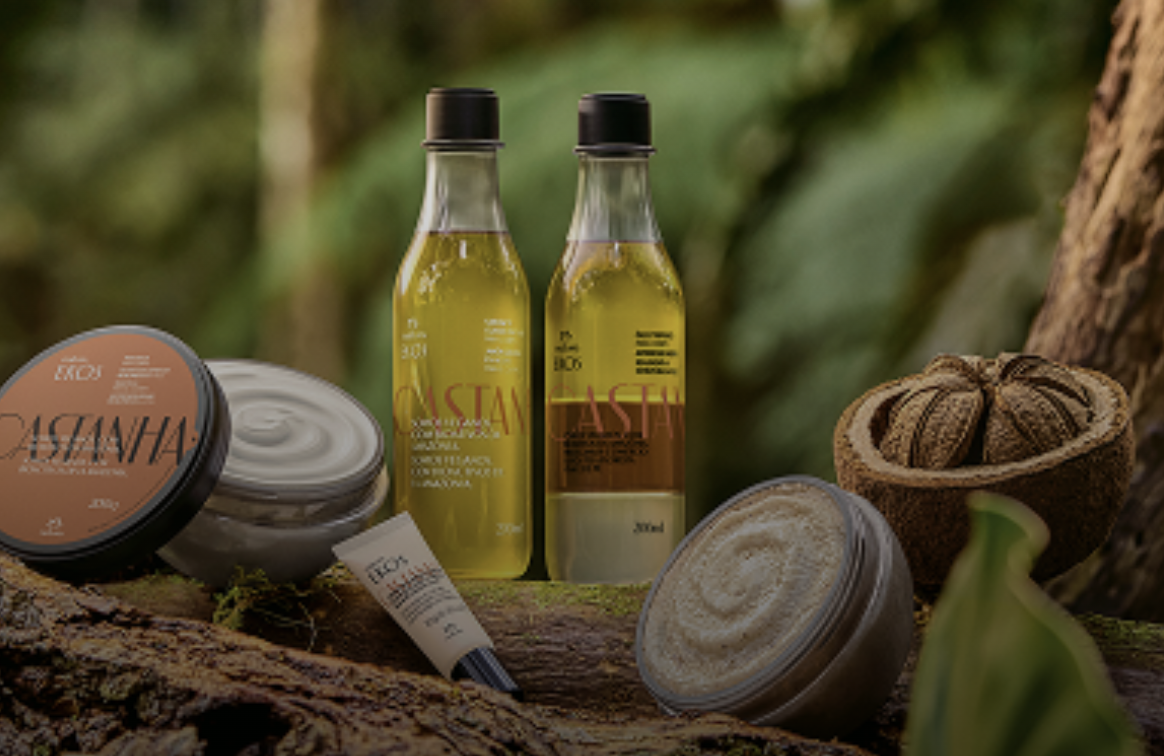
A recent product, launched in 2025, is the Ekos Cacau line. The cocoa used in the Ekos line is cultivated in agroforestry systems (SAFs), a regenerative practice that combines the planting of the raw material with other native species, such as Brazil nut, taperebá and ipê, in degraded areas. This cultivation model already contributes to the recovery and conservation of 8,116 hectares of forest in the region. The novelty benefits 189 families from two supplying communities, reinforcing the bioeconomy as a concrete alternative to deforestation.
Natura was a pioneer in refills, launching them as early as 1983. Today, 84% of our packaging is reusable, refillable, recyclable, or compostable. We see high repeat purchase rates because refills are now deeply integrated into our customers' routines. Part of this is due to the incentive provided by our beauty consultants, who, at the point of sale, reinforce the economic and environmental benefits of choosing the refill.
Future outlook
re/sources: How do you see the future of sustainability in the Brazilian market?
Diego Costa: The future of the Brazilian beauty and personal care market over the next 3 to 5 years presents a clear opportunity in the consolidation of the bioeconomy and radical transparency. Based on Kantar data and consumer behaviour studies, the greatest opportunity lies in converting high purchase intent into concrete actions by democratising access to sustainable products. This means that brands able to balance high dermatological performance with real circularity models (such as expanding economically attractive refill systems) and ethically sourced ingredients, like Amazonian bio-actives, will dominate audience preference, as an audience no longer accepts "green marketing" alone but demands tangible proof of regenerative impact.
On the other hand, the biggest threat to this growth is the scepticism generated by greenwashing and price sensitivity in a volatile economic scenario. If companies fail to achieve price parity and clear communication regarding their "Clean & Safe" health and safety benefits, consumers may revert to conventional consumption habits based strictly on convenience. The challenge for the coming years will therefore be to transform sustainability from a "premium" attribute into an invisible standard of quality, where environmental regeneration and positive social impact are inseparable from the value proposition of any leading brand, at the risk of losing relevance and social license to operate.
Angela Pinhati: I see the transition to the Bioeconomy as an important step. True progress is measured by replacing extractive supply chains with models that keep the "forest standing." At Natura, we see that sustainability has moved beyond being just a department to become the product technology itself, utilising biodiversity bio-actives ethically. This goes beyond marketing; it is a fundamental shift in the beauty production matrix.
Certifications will be an Antidote to Greenwashing. The use of rigorous seals (B-Corp, UEBT, Leaping Bunny) is proof that we are moving from the era of promises to the era of radical transparency. Professionally, we observe that the market is maturing: consumers are more vigilant, and companies lacking solid governance to back their claims are losing their social license to operate.
The greatest challenge - and perhaps the biggest critique of the industry - is scale. While leaders like Natura have implemented reverse logistics and refill systems for decades, the industry at large still struggles to abandon virgin plastic and single-use models. Progress is real, but the pace is still driven more by consumer pressure and regulation than by a unified, voluntary sectoral initiative.