

The Sustainable Beauty Coalition (SBC) has been developing “A Journey to Reuse”, a guide to help beauty professionals working in product development, sustainability or packaging teams within beauty brands, retailers, and suppliers.
Drawing on consumer insights and market examples, the guide explores reusable programs and refillable packaging to support system building and product development and drive a sustainable shift within the beauty industry.
The playbook aims to help beauty brands take their next best step by assessing where they are, understanding the pressure points, feeling inspired by case studies, getting clued up on relevant issues and identifying solutions that are good enough for the next step.
Progression Over Perfection
This guide is for sustainability and packaging teams in beauty brands, retailers, and suppliers looking to move from pilot to scale in the beauty sector. It is meant to spark conversation, inspire, provide information and ultimately encourage brands to take actionable steps towards more reusable and refillable packaging in the beauty sector.
Each chapter contains relevant information and interactive sections that can guide internal strategic conversations to help you build a business case, determine whether it is the right step for the business, and get buy-in.
If widespread adoption of reusable, low-impact packaging for beauty is the goal, the journey must be collaborative. Each player moves at their own pace and in their own style, and the guide has been designed to meet beauty professionals where they are at and encourage commitment and action.
From linear to circular
In the 3 R methodology - Reduce, Reuse, Recycle - Reuse is the second element, inspired by the waste hierarchy, making it a top priority in sustainable development for beauty. With this guide, the coalition wants to remind brands and consumers that recycling should be the last option, and that reuse should be a key strategic move.
The SBC also recognises that refillable models are not perfect and do not work for everything, but by sharing guidance on how to approach refills, it hopes to bring vision to reality and foster more success stories in the future.
Refillable is a matter of “ecosystem” rather than isolated ideas and requires careful thought, hence this guide.
We know that reusable packaging needs to be at scale to be cost-effective. Without enough participants, infrastructure and logistics remain expensive. But as more brands join, costs drop, benefiting everyone. The “Unlocking Reuse” report by EMF found that for Personal Care packaging, a systemic-level move to reusables would reduce costs up to 23% for everyone.
The business case for refill
Reuse can cut the costs of packaging and transportation, for instance, by supplying refills for reusable containers in compact form, such as concentrates or solids, e.g., tablets. It can also reduce costs at scale for distribution and logistics by sharing reusable packaging across brands, sectors, or wider networks.
Reuse can also encourage consumer customisation and improve user experience. Individual needs can be accommodated by reuse models that let users mix and match flavours, personalise packaging or choose desired quantities. Think make-up palettes, but “for me”. User experience can be improved by enhancing the look, feel, or functionality of reusable packaging (which can be higher-end, as initial production costs are spread across many uses).
“ Did you know that the ANGEL perfume bottle, launched in 1992, was actually made a refill, because the bottle was really expensive and needed to be used more than once by the consumer to offset manufacturing costs. And to enhance the in-store experience, they gave beauty advisers white gloves to hold and refill the bottles, giving consumers a luxurious experience.”

Reuse can also help build brand loyalty while generating key data points. Customer retention can be achieved through deposit and reward schemes for reusable packaging, while information on user preferences and system performance can be collected by incorporating digital technologies such as RFID tags, sensors, and GPS tracking into the reusable packaging system.
Success stories to build on
Beauty Kitchen and Arran Aromatics with the Reposit scheme:
Two prominent Scottish brands partnered to scale the use of reusable packaging through Beauty Kitchen’s Reposit platform. This initiative demonstrates how independent brands can align on a shared reuse model, leveraging Reposit’s deposit-return system to make circular packaging viable for smaller players.
The model is based on customers purchasing products in standardised reusable containers and returning empty packaging at either brand’s points of sale or online through free post, enabling “buy from any brand, return to any participating location.
M&S & Reposit (UK)
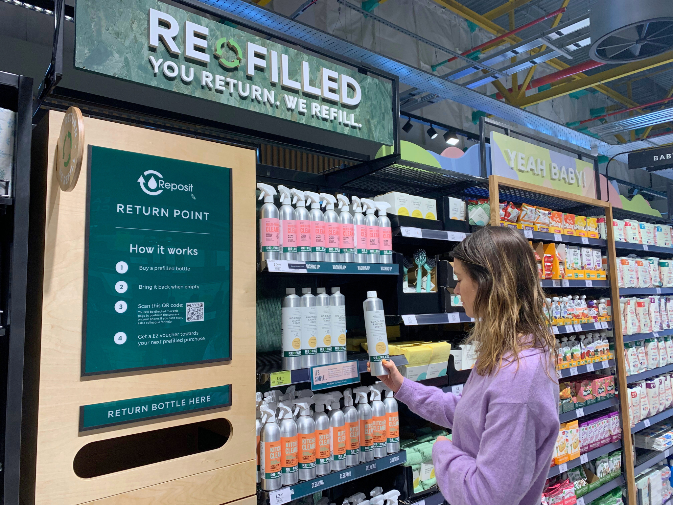
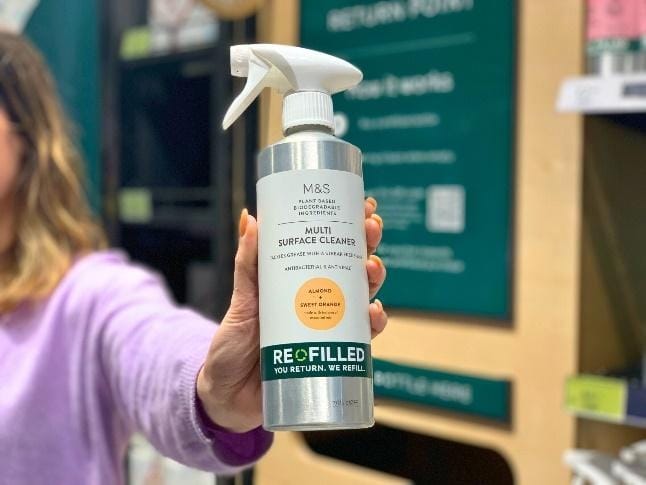
Marks & Spencer (M&S), in collaboration with Reposit, City to Sea, and Ecover, launched a pioneering initiative to tackle single-use packaging through a scalable reusable packaging system. After a 2020 pilot with home care products, it has now expanded to 25 stores and 10,000+ customers participating as of February, 2025.
The model works on customers paying a refundable deposit on standard reusable containers (aluminium bottles). “Buy anywhere, return anywhere” through participating stores or home collection. Reposit technology tracks containers throughout the system.
Pharma-Recharge in France:
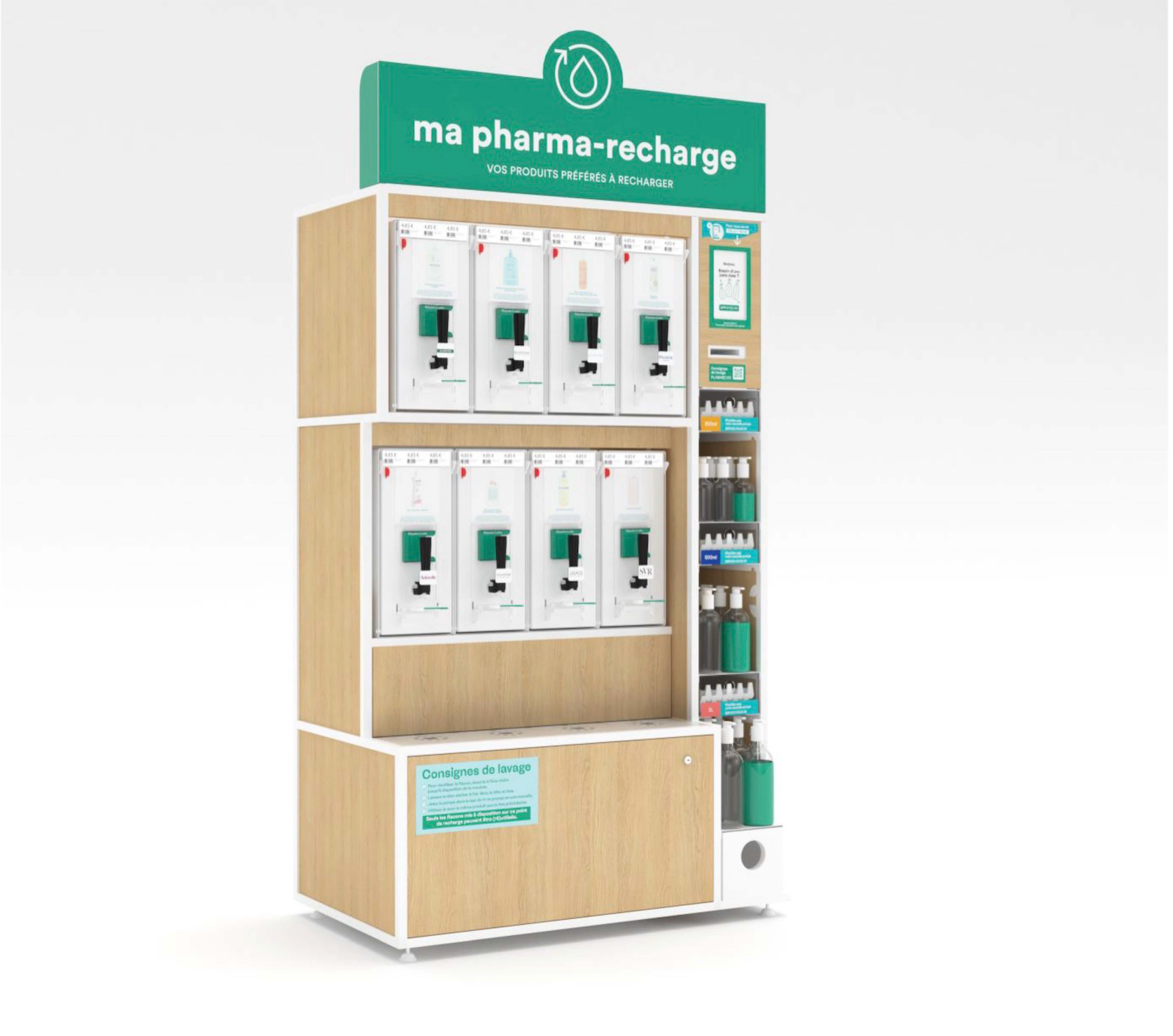
Launched in 2023 by a consortium of French dermocosmetic brands (Garancia, Bioderma, Pierre Fabre, La Rosée, Mustela). Pharma-Recharge installs refill fountains in pharmacies for multi-brand products such as shampoos, shower gels, and micellar waters.
The model is based on consumers purchasing a standard 500ml glass bottle (€1.99) and refilling through sealed, automated dispensing systems that print regulatory labels for each refill. Refills offer 15-20% savings. After four months, 90% user satisfaction and 99% support for reuse. System ensures hygiene, traceability, and regulatory compliance across multiple brands.
The brands agreed to develop a standardised bottle to optimise the process. Something that seemed impossible a few years back is working well. Talking with Pharma-recharge, we learned that the professional advisory was also key in the customer journey. The refillable machines are placed in pharmacies, are very visible - which in itself generated interest from consumers -, and staff often direct consumers to use them. In the second year of the project, they simplified and clarified the labelling and directions for use to increase adoption and improve the consumer experience.
Why refills
By promoting reusable and refillable products, beauty brands can lead the cultural shift toward packaging that’s valued rather than discarded. This playbook is a collaborative project from the Reuse & Refill Taskforce of the Sustainable Beauty Coalition (SBC), part of the British Beauty Council.
The Sustainable Beauty Coalition aims to accelerate sustainability in the beauty sector through collaboration, policy advocacy, and strategic action.
Key goals include:
- Unified Industry Collaboration
- Policy Development
- Cross-Sector Partnerships
- Climate Strategy
- Support for Green Initiatives
Join us to support a wider adoption of refills. We can only achieve this together.

